
Why your net worth is hard to see
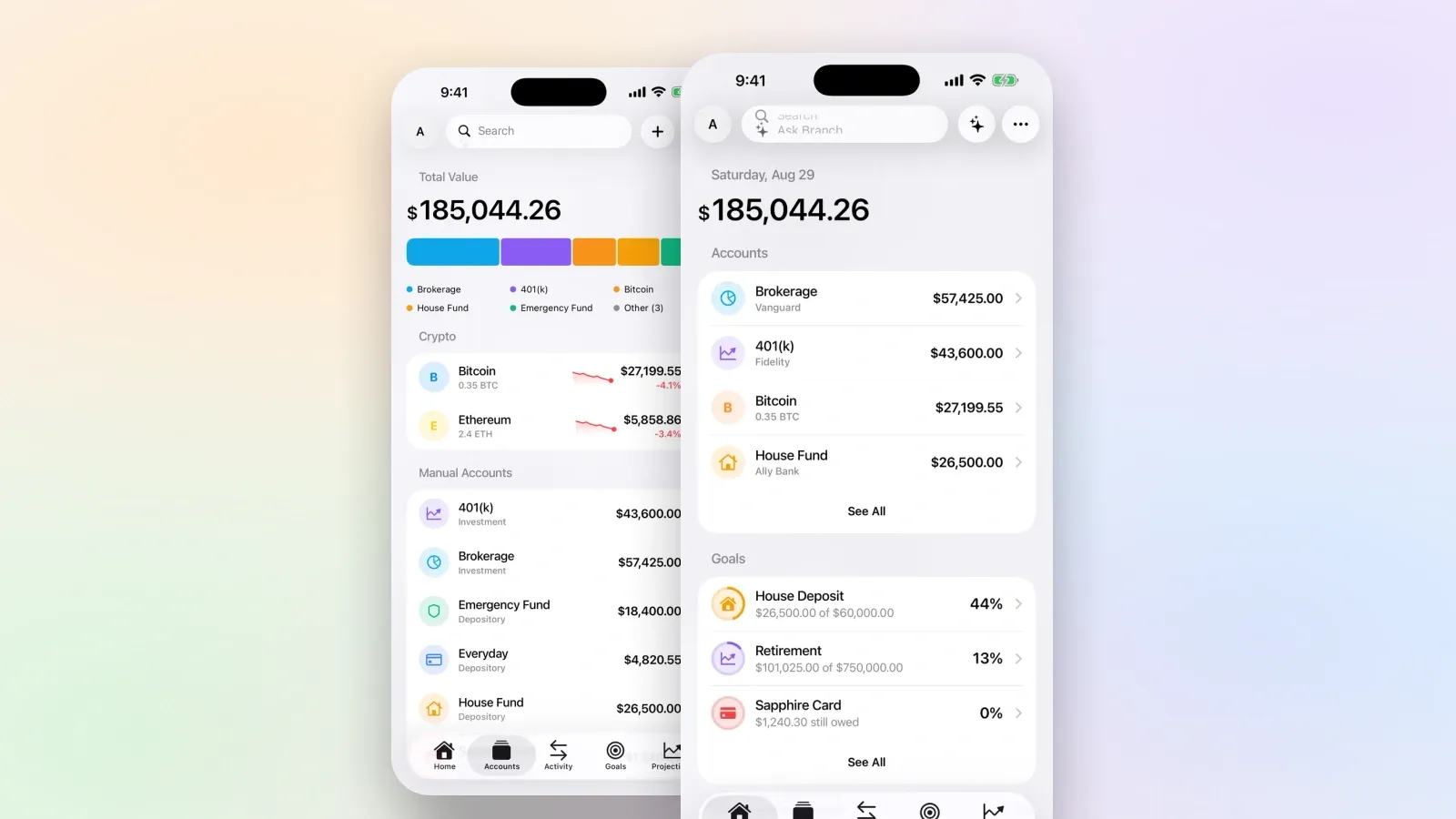
Most people do not have a money problem so much as a visibility problem. The current account is easy to check. The pension, the brokerage, the exchange account and whatever is sitting in a drawer are not.
The number nobody shows you
Your bank shows you your bank. Your broker shows you your broker. Neither adds the other one up, and neither knows about the gold coin you were given years ago. So the number you actually care about — everything you own, minus what you owe — exists only if you sit down and build it yourself.
That number is your net worth, and the definition is genuinely that simple:
Net worth = everything you own − everything you owe
One subtraction. No formula, no methodology, nothing to get wrong. What makes it hard is not the arithmetic — it is that the inputs live in eight different places and three of them do not send you a statement.
What belongs on each side
Things you own tend to be undercounted, because the ones that are easy to forget are the ones you do not log into:
- Checking and savings accounts
- Retirement accounts — a 401(k), an IRA, an old plan from a job you left
- Taxable brokerage accounts
- Crypto, on an exchange or in a wallet you control
- Physical assets with a real resale market: a car, gold, a watch
- Property, at what it would sell for today
- Money other people owe you, if you genuinely expect it back
Things you owe tend to be over-remembered — the mortgage feels enormous because you think about it — while the small ones quietly add up:
- Mortgage balance
- Car loans and student loans
- Credit card balances, including the one you clear every month
- Anything financed at zero percent, which is still debt
Worked through, it looks like this:
| Checking | $6,200 |
| Savings | $18,000 |
| 401(k) | $84,000 |
| Brokerage | $31,000 |
| Crypto | $9,400 |
| Home | $240,000 |
| Total assets | $388,600 |
| Mortgage | −$198,000 |
| Car loan | −$14,300 |
| Credit card | −$2,100 |
| Total debts | −$214,400 |
| Net worth | $174,200 |
Nobody in that picture is poor or rich because of any single line. The $240,000 home and the $198,000 mortgage are the same decision seen from two sides, and looking at either alone tells you almost nothing.
The things that do not have a price
Bank balances are facts. Most other values are estimates, and this is where people either give up or start lying to themselves.
The workable rule is to value something at what you could actually sell it for, not what you paid and not what you hope. In practice:
- A car — take a current valuation from a site that prices your make, model, year and mileage. Not the purchase price.
- A home — a recent sale of a comparable property nearby beats any automated estimate, and both beat what you paid in 2019.
- Gold, silver and watches — spot price for metal by weight; for anything collectible, what comparable pieces have actually sold for, not asking prices.
- A private business stake — most people carry it at zero until there is a real offer. That is conservative, and conservative is correct here.
Be consistent rather than precise. A home valued the same way every month shows you a trend you can trust. A home revalued optimistically in good months shows you nothing.
Three ways people do this, and where each breaks
Your bank’s app. Zero effort, and wrong by construction — it can only see the accounts it holds. It reports a slice as though it were the whole.
A spreadsheet. Genuinely good, exactly once. You build it on a Sunday, it is accurate that afternoon, and then prices move and you do not. Within a month the total is fiction. The maintenance is the problem, not the math.
An aggregator. Connects to your institutions and refreshes on its own. The failure is different: connections break silently after a password change, and manual assets — the car, the metal, the private stake — are usually second-class citizens, if they are supported at all.
Every approach fails at the same seam. Something in your life is not connectable, and the tool either ignores it or makes you maintain it by hand forever.
How often to update it
Monthly, on roughly the same date.
Checking daily is actively counterproductive: the number moves with the market, you have no control over that movement, and watching it invites reacting to noise. Checking yearly is too coarse to notice a trend you could still change.
Monthly is frequent enough that the trend is real and infrequent enough that you are looking at your decisions rather than the market’s mood. The trend is the point. A single net worth figure is trivia; the same figure across twelve months tells you whether what you are doing is working.
What Branch does differently
Branch connects to the accounts that support it and lets you add by hand anything that does not — the car, the metal, the stake in a friend’s company — so the manual things sit alongside the connected ones instead of living in a separate spreadsheet. Crypto is priced continuously against the market.
Every holding also keeps the price you paid for it, so you see both what something is worth today and what it cost you. That second number is the one almost every app throws away, and it is the one that turns a balance into a decision.
The connection is read-only. Branch can see your accounts to build the picture; it cannot move money.